
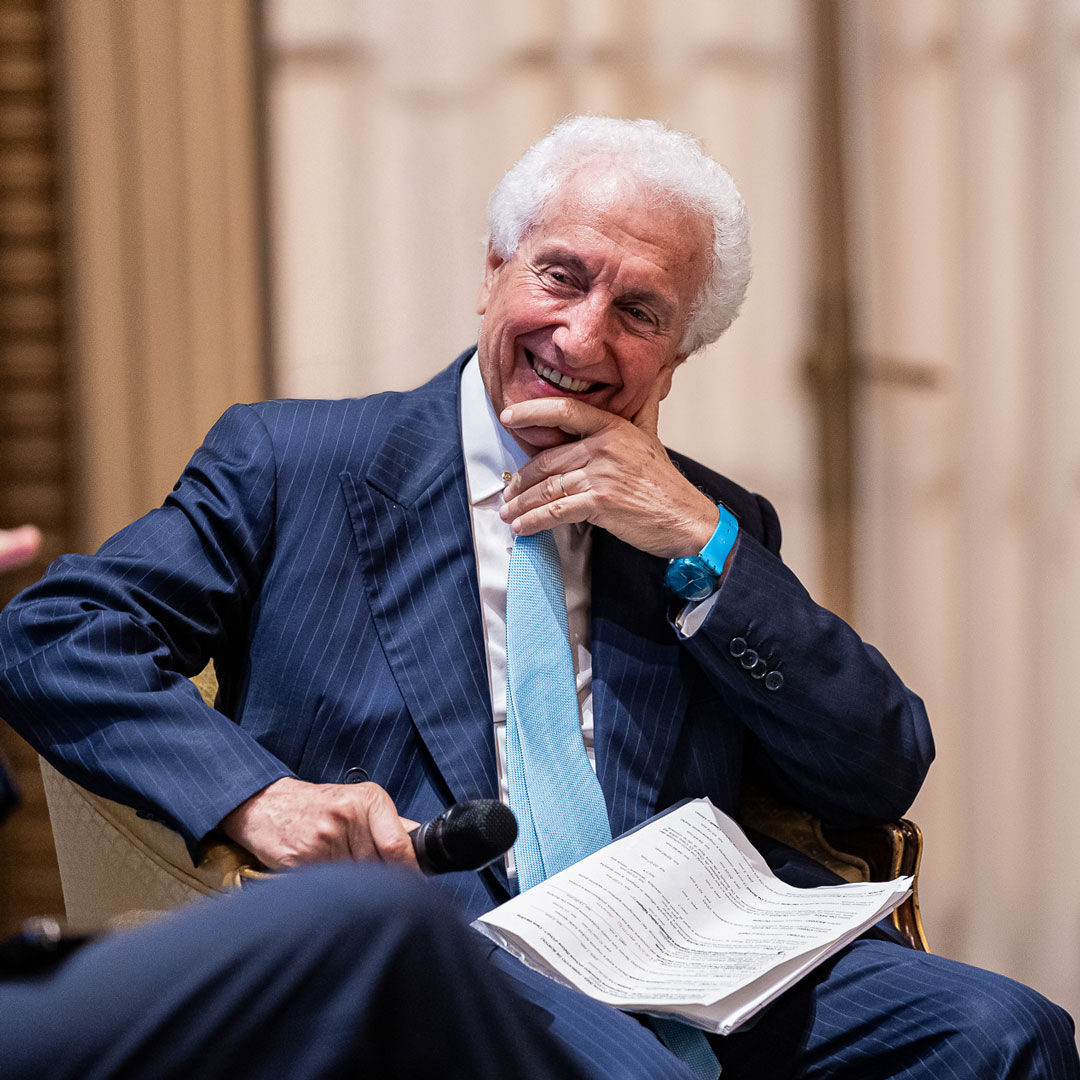
Stefano Balsamo, chairman Italy of JP Morgan for 56 years, founded the Canova Club in Rome in 1978—at first, simply as a workable way for banking professionals to find each other. What started as an informal arrangement has, over time, grown into a community of several hundred members in Rome and Milan, alongside the international Diplomatia network.
Balsamo refers to himself as an “aggregator of people”, a definition that reflects a natural inclination toward leadership and a practiced ability to build relationships based on friendship, culture and a concrete sense of solidarity—values that have gradually, and quite deliberately, shaped the identity of the Canova Club.
When and how was the Canova Club founded, and what is its vision for the future?
It began in Rome, at Bar Canova in Piazza del Popolo, out of a straightforward professional necessity linked to my work: understanding what Italians employed by foreign banks were actually doing. There was nothing conceptual about it—just a pragmatic, distinctly “American” approach, focused on concrete outcomes rather than abstract discussions.
The real turning point came when we started inviting external experts to share their knowledge—such as the then largely unknown Giulio Tremonti in 1978, followed later by Mario Draghi, Piero Angela, and several other figures who would only become famous much later. That shift—from narrowly technical meetings to more open conversations—quietly transformed the group into a place of friendship and culture, where culture meant building relationships beyond affiliations in order to enable the exchange of ideas.
As things evolved, it became necessary to give some structure to what had originally been informal gatherings, resulting in around thirty services built on our core values: Friendship, intended as a spontaneous gift; Culture, as a serious commitment to sharing knowledge; and Solidarity, directed toward supporting “those without provision”. What began as a vertical exercise focused on finance has since become a horizontal community, bringing together people from different backgrounds around cultural initiatives and social support. The model remains intentionally simple: members and stakeholders come together not to attend, but to contribute—personally and directly. We will also be opening a Canova Club in Naples shortly, following the same spirit of friendship and simplicity that proved workable in Milan after Rome.
Over the past three years, I have focused on ensuring that the Club is able to continue without me. This process led to the creation of the Foundation and to a governance structure with presidents and general directors, including Chiara Di Ciro, general director of the Canova Club Milan Foundation; Federico Ghizzoni, president of Canova Club Milan; Francesco Farinelli, general director of Canova Club Rome; and Giancarlo Abete, president of Canova Club Rome.
What are the initiatives of Canovalandia, the Third Sector organization?
We operate under the motto “Providing for those without provision.” In concrete terms, this means working alongside the very last of the last—contexts where good intentions are not enough and where structures simply lack the entrepreneurial or managerial tools to sustain themselves. My role is to raise funds from members and—now that any banking-related conflicts of interest are firmly behind me—to organize initiatives in a more orderly way, while deliberately keeping the entire operation voluntary.
A defining trait of the organization is a certain rigor in making sure that funds actually go where they are meant to go. Documentation is always requested; trust is important, but verification is non-negotiable. In Rome, we support initiatives such as Docce al Colle Oppio for people experiencing homelessness and Casa di Lorenzo, which welcomes young people with Down syndrome. In Milan, we collaborate with Ronda della Carità e della Solidarietà ODV, assisting people without shelter, and with Asilo Mariuccia, which provides physical and psychological support to mothers and children in difficult circumstances.
Could you tell us about the rebranding, carried out in collaboration with Inarea?
The rebranding was the final step in stepping out from the founder’s “shadow cone” and releasing the Club from an image that had become, admittedly, a little too centered on me. It was meant to signal a clear change of phase, summed up—without excessive reverence—in the deliberately self-ironic slogan: “Balsamo asks Stefano to leave the command post.” I agreed to the change of logo not out of nostalgia, but out of responsibility toward the Club and its future. I was struck by Inarea’s generosity and level of commitment, particularly by their ability to listen rather than impose. In the new visual identity, the double “C” remains as a sign of contact and friendship, but its meaning has been recalibrated. What once alluded to the coin, a nod to the Club’s financial origins, now refers to the person—expanding the notion of community and relationship that today, quite clearly, defines the essence of Canova.